
Dr Alan Gilston: The architect of the Intensive Care Society
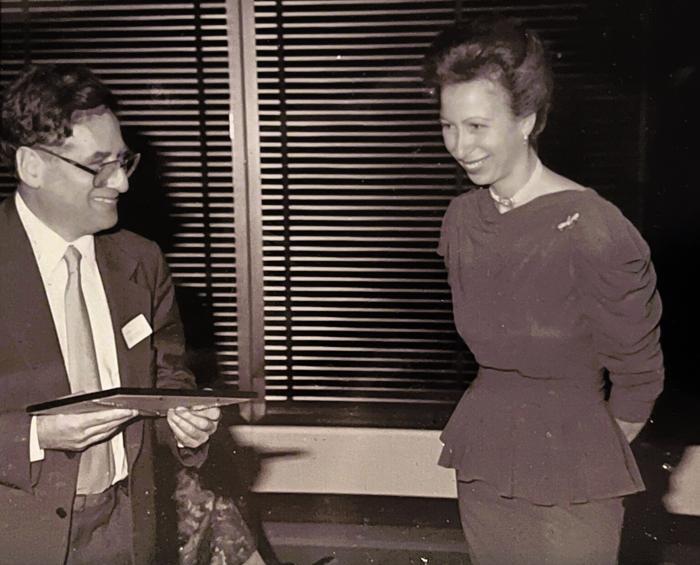
Dr Alan Gilston (b.1928 - d.2005) pictured above receiving an award from HRH The Princess Royal, for his contribution to intensive care medicine.
Dr Alan Gilston
Dr Alan Gilston, a consultant anaesthetist with a relentless drive, didn't just witness medical history, he built the foundations upon which the Intensive Care Society stands today. His son, Rafael Gilston, donated some of his late father’s research back to the Society and shared stories of how and why Dr Gilston founded it.
In May 1968, the UK medical world held its breath as the first-ever heart transplant was performed at the National Heart Hospital. While the surgeons made the headlines, it was a recently appointed consultant anaesthetist, Dr Alan Gilston, who went over and above to ensure the patient survived the night, and the procedure was a success.
In a display of the dedication that would define his career, Dr Gilston refused to leave his patient's side, sleeping on the floor of the operating theatre. It was a move that saved a life; when a central venous line became displaced in the night, he was there to replace it instantly. Two years later, in 1970, this interest in the complexities of intensive care medicine led him to found the Intensive Care Society.
A society "for the people"
Dr Gilston recognised that because intensive care drew from the whole medical and specialist spectrum, the field needed its own representative entity to bring these diverse roles together. At the time, professionals were separated by their own individual bodies, and there was no single home for the collective "intensive care" identity. He wanted an entity that wasn't just for doctors, but for everyone - nurses, anaesthetists, and pharmacists alike.
He believed in a multidisciplinary community, and in the original draft structure of what the Intensive Care Society would become, he wrote: "Membership must be open to all disciplines, and this must be actively encouraged, for it is fundamental to the aims of the Society."
Despite facing significant pushback when proposing an independent society, Dr Gilston’s characteristic determination saw the project through. His son, Rafael Gilston, notes that his father was “the type of person who, when they have something in their mind to do, he would make sure he achieved it - and to a high-level."
The birth of the State of the Art Congress
To fund this new dream, Dr Gilston organised the first State of the Art Congress. Expecting a modest gathering of 200 people at Imperial College, he was stunned when over 2,000 professionals arrived. The demand for a dedicated intensive care community was undeniable.
Recently, the Society was honoured to welcome Rafael Gilston to our offices. He delivered a "treasure trove" of his father’s legacy: hundreds of 35mm slides containing presentations, research and lecture notes. These slides are more than just historical artefacts; they are a map of how intensive care evolved from a fledgling idea into the vital specialty it is today.
We will be showcasing these slides at SOA26, so our community can admire and share in the history of our society.
A living archive
Dr Gilston was committed to sharing knowledge, travelling the world, spending time in different countries to learn alternative methods, bringing best practice back to the SOA stage. Even in retirement, he never stopped.
He founded JICS to offer a specialist style of publication that didn't exist elsewhere, continuing to research, file, and take notes, remaining active in the advancement of intensive care medicine.
As we celebrate Heart Month, we honour the man who started with a passion for the heart and gave the Intensive Care Society its soul.