Nature on Full Life Support: King’s College Hospital Launches UK’s First Outdoor Critical Care Roof Garden
The King’s Critical Care Centre has officially opened the UK’s first dedicated outdoor Critical Care Roof Garden. This innovative space allows up to six critically ill patients to experience fresh air, greenery, and natural light while remaining connected to full life support and intensive monitoring systems.
The Vision
The project is the final phase of the King’s Critical Care Centre, one of the largest bespoke intensive care facilities in the UK, supporting over 5,000 patients annually. Designed through a collaboration between landscape architect Professor Nigel Dunnett and three-time RHS Chelsea Flower Show gold medallist Sarah Price, the garden features an intentional planting strategy. It combines native species with aromatic and tactile plants like rosemary, sage, and lamb’s ear to encourage active sensory engagement.
The £2m project was funded by King’s College Hospital Charity alongside Trust funding.
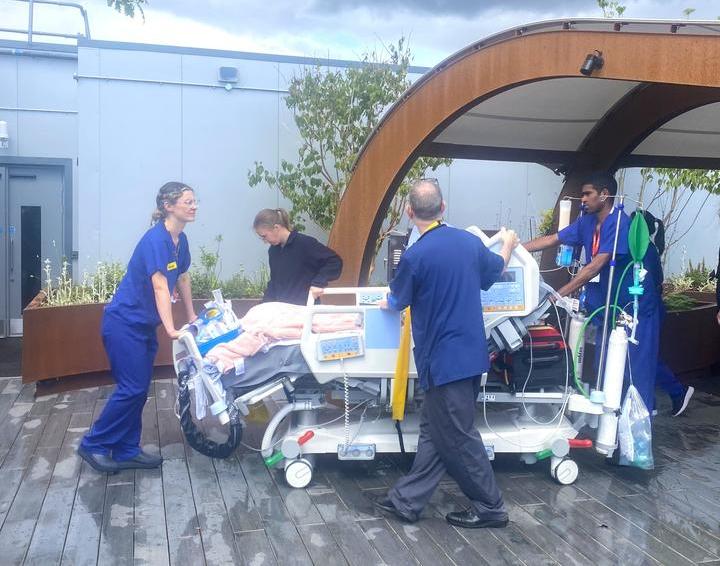
Image credit: King’s College Hospital NHS Foundation Trust
Behind the clinical logistics
For intensive care professionals, moving a patient on full mechanical ventilation and invasive monitoring to an outdoor roof space raises immediate operational questions. Dr Tom Best, Clinical Director of King's Critical Care, broke down the logistics, risks, and clinical philosophy behind this milestone.
Patient selection & moving safely outdoors
While strict, inclusion criteria are still evolving, the team uses the foundational framework established in the Guidelines for Provision of Intensive Care Services (GPICS) for rehabilitation pathways to outdoor spaces.
- The setup: The garden features weatherproof medical docking stations embedded directly within the landscaping, providing seamless access to power, data, and medical gases.
- Staffing: Dedicated nurse accompaniment remains standard. Each transfer utilises the flexibility built into GPICS staffing models (including ACCPs and team leaders).
- Unit autonomy: King’s physically operates 97 critical care beds across multiple specialised units (Neuro, Trauma, Liver, General ICU), with each unit maintaining autonomous access to the garden. Patients will visit for short intervals rather than all day, eliminating the need for complex cross-unit scheduling.
Navigating infection control
Infection risk is a primary concern for the intensive care community, particularly regarding highly vulnerable or immuno-compromised patients. Dr Best emphasises a balanced, pragmatic approach:
- Low cross-infection: Outdoor environments inherently pose a very low risk for cross-infection. The garden features zero stagnant or running water to mitigate specific environmental pathogens.
- Inclusivity: The team is actively working to ensure patients with resistant organisms are not automatically denied access to the space.
- Equivalency of risk: Moving a patient to the roof garden carries the same calculated risk as standard transfers to other hospital areas, a car park, or a helideck. Every transfer undergoes a rigorous, individualised clinical risk assessment with full next-of-kin awareness.
The ultimate expression of "Humanising the ICU"
With the upcoming State of the Art (SOA) Congress hosting sessions on Humanising the ICU from a Patient Perspective, this garden serves as a tangible proof of concept.
Dr Best references Winston Churchill’s famous adage: "We shape our buildings; thereafter they shape us." Modern intensive care medicine has evolved to deliver "magic bullets" through data and technology but has occasionally ignored the physical environment. Air conditioning and harsh clinical lighting can trigger severe ICU delirium and hallucinations, delaying physical recovery.
By contrast, control over natural elements; hearing the rain, seeing a family pet, or feeling sunlight, acts as a powerful psychological trigger for recovery.
Iona Joy, Director of Grants and Insight at King’s College Hospital Charity, said: “We are delighted to have funded this visionary project, which is about more than medical excellence. It’s about dignity, humanity, and innovation. We are transforming intensive care into compassionate care - where science, technology, and empathy work together to save and rebuild lives.”
Crucial respite for ICU staff
The garden is as much a tool for staff wellbeing as it is for patient rehabilitation. Intensive care staff routinely spend consecutive hours isolated in intensive cubicles with highly unstable patients.
- A lovely environment to care: The roof garden offers immediate environmental respite for the 1 or 2 staff members required to accompany each patient.
- Wellbeing through excellence: Staff wellbeing is directly linked to the quality of care they are enabled to provide. By giving clinicians the environment and tools to deliver superb, compassionate care, the garden actively helps mitigate the chronic burnout associated with intensive care settings.
The next horizon: funding and research
While the New Hospital Programme (NHP) has visited the site, mandating these spaces in all future UK hospital new-builds remains difficult due to upfront capital costs and regressive design habits. Many hospitals hold shared, unexploited outdoor spaces that could be transformed through targeted hospital charity funding.
The King’s Critical Care team will now spearhead formal research to track the long-term impacts of the garden. The department will study whether structured outdoor exposure:
- Reduces ICU delirium and shortens the overall length of stay.
- Lowers patient blood pressure and stress markers.
- Improves long-term physical, cognitive, and psychological outcomes post-discharge.
- Manages stress levels for families and ICU staff.
Ultimately, the team believes that investing in patient experience directly translates to financial utility. Speeding up cognitive and physical recovery leads to shorter bed occupancy, faster rehabilitation, and an accelerated return to work for patients.
Join the conversation:
At SOA 2026: Be part of the 'Humanising the ICU' conversation, alongside sessions on rehabilitation, GPICS v3 and the future of ICU.
ICS Cast: Keep an eye out for upcoming podcast episodes discussing this topic in detail.
Get in touch: For further information on the project, contact: Corporate Communications, King’s College Hospital NHS Foundation Trust.
Tell us your story: If your hospital has a good news story you'd like us to share, write to us at communicationsteam@ics.ac.uk